All posts by Urban Eve

Unknown's avatar

About Urban Eve

I'm a Black woman in a white washed world which is shifting gradually and beautifully into consciousness. I have an overdeveloped sense of play, a love of nature, art, photography fashion, literature, irreverence, irony. I am a late bloomer, a girly woman, a sado-sensualist, a pleasure cooker, a shedonist, a huge film fanatic, lover of DIY craft and the endless gifts of nature. I love that I was born a Black Woman because there is no limit to the potential I will unfold and manifest through my re-connection to my rich, broad, magical, spiritual history and ancestry, through research, community, nature, prayer, imagination and creativity. I like being still, moving swiftly and creating instinctively.

Street Harassment or Public Flirtation? How do we define it?

“God Bless you darling”

“Have a good day dimples.”

Those are the two I’ve heard addressed towards me this week and I thanked them both politely and went about my day. I imagine that these comments might be unwanted by a different woman walking down the street and I can appreciate and respect that. But I would hope that she could also open her mouth and say, “No thank you.” or “I don’t appreciate that, will you please stop?”

Ever since the video of Roberts’ recorded experience of being addressed by strange men in the street was released, my nerves have been somewhat on edge whenever an online conversation flares up which generalizes or defines what occurred flatly as “Street Harassment” that should be criminalized. What is “Street Harassment” please? Who does it and what does the face of a possible campaign against it look like? Who would it serve?

“Hey Ma, my man over there thinks you’re cute and wants your number.” That’s one I used to hear endlessly in High School.

If you think the guy is cute, is it still “street harassment” because thousands of hook ups and even marriages begin this way.

When single women go to bars to meet men, those men are strangers. This game the sexes have always played has required men to be the initiators and for women to be the ones who decide whether they will respond affirmatively or with displeasure for what ever reasons.

For me, harassment whether in the street or in the office or in a bar, club, or wherever is what occurs after you have expressed the desire to no longer be pursued. Men will pursue. That’s what they do. That is what we have required them to do. And I don’t care how anti-feminist or offensive this sounds but it’s what many women like them to do.

I was hanging out with a male friend of mine yesterday and I asked him he felt about this issue. Interestingly he is the second Black male who told me he didn’t really care about it but started paying attention when he noticed that most all the men in the video were of color.

As to the question of how men would respond if it was the other way around and woman were always cat calling, whistling and making kissy noises at them, please! Does anyone need to take a poll or do a hidden camera segment to know what the overwhelming response to that would be?

That would save men like 80% of their time!

I’m not saying I haven’t had men say things to me in the street that I haven’t found infuriating. But I always chalk it up to that one particular guy or incident, not all men and certainly not all Black men. I can’t even imagine how I could! I guess I’ve just never found it to be an issue for me.

Now I get how patriarchy plays into our internalized normalization of this occurrence but as women with intelligence, voices, and power, we also have to be aware of the ways in which we contribute to the appropriation of gendered social cues. Because to me, there are situations in which the same women who hate to be called out in the street, require this same amount of assertion in a setting where they crave attention and flattery. Again, if the attention is unwanted and this has been made clear but still continues, you are now dealing with a harassment case.

Do I think a man is wrong or bad mannered or a rapist just because he says something to me I don’t want to hear in the street? No. But if he pursues me after I have made it clear I have zero interest, then he has a problem. And at that point, I have to do what I can to protect myself and my rights.

And finally, compliments from men I don’t know in the street have yielded feelings of positive reinforcement for me on several occasions. I’m not saying I know who is harmless or who is potentially dangerous. I’ve also gotten compliments from women in the street and love those as well! What I’m saying is, I wish there was more carefulness around the definition of “street harassment” and not this dangerous lumping in of “How are you today”s and “God Bless you”s and “You’re beautiful”s with a general sense of being made to feel unsafe.

Roberts also makes a general statement about places where people don’t experience harassment.

“People don’t put up with harassment at work, at school, at home. And we shouldn’t have to put up with it in the streets. I have a right to feel safe.”

WHAT????

Women get harassed everywhere and have been for ages! They’re being harassed this second. If she only gets harassed in the streets and not at school or in the office than good for her but that sounds kind of like a generalization to me. Who are these people who don’t get harassed at work or in school or at home? What strange new world does she live in and can I visit? I just feel like this issue has become about about one women’s experience and I don’t seek to undervalue her experience or her feelings but I worry that her testimony speaks for the experience of other women in ways that are not accurate and I hate it when one person speaks for others in even the smallest ways without checking in on them. There has to be an attempt at balanced and fair reporting that includes opposing viewpoints in order to have a truly constructive conversation about this issue.
Inspiring Envy

When I was a girl in the 80s I can remember when I first started hearing stories about kids in the Brooklyn getting killed over their sneakers. In the 90s I wrote a story for New Youth Connections about many of the items made in America that supported the Apartheid regime in South Africa. These issues heavily influenced my decision not to buy sneakers, at least not popular ones, period.

A few months ago this year I was in my local AT&T store in Harlem upgrading my iphone 4 to the 5s model. As I was sitting there at the table waiting for young lady attending to me to check on a few things, I looked around the store at the standard set up. I noticed the motto in large print against one the walls opposite from me for the new HTC phone. It read “Built to inspire envy.” My immediate reaction was, why would you want to inspire envy? The two words put together are the evil genius of advertising. Naturally I was implicit in all of this because here I was upgrading my phone, a phone that my husband would repeatedly warn me to never expose in public because of stories in the news about rampant theft of iphones, particularly in the subways. And yes, I realize that the intent of Big advertising has been evil for some time. But for some reason, reading that logo in the AT&T store that day made me realize that we as consumers willingly contribute to the inspiring of envy to a staggeringly larger degree than the inspiring of creativity and self knowledge without even really thinking about it. Our whole society screams out, “Look at what I have! Don’t you want it too? Want what I have! Aspire to look like me and live like me, talk like me, smell, look, dance, dress like me!”

Advertising is smart, sexy, and seductive and as a rule plays on our greatest weakness, the idea that we are not enough. I’m no exception. I may be selective about my vices but I still have them. I don’t watch television very much (except on Scandal Thursdays) but when I get online, that’s when I really have to curb myself. There is just so much information coming at you at speeds impossible to process, and you’re taking in stuff, you’re not even aware of. Because of the ways in which online and television media speaks to stereotyping and trendsetting, definitions of beauty, sex, entertainment and object worship, we as human beings are often walking advertisements ourselves. So advertisement also inspires isolation, because a culture of people who cannot engage with one another beyond the compatibility of product placement on our bodies can never truly connect at all.

Overall, it made me a bit panicky. It was like having someone tell you that although you never pulled the trigger to kill Bambi, you actually made a donation to the foundation of killing Bambi when you bought your cell phone. Do people still care about Bambi? Is that a dated reference? The point is we live in a country that as Chris Rock says commercializes everything. That doesn’t surprise or bother me as much as the desensitization. It would be different if the things we acquired made us happy, jumping up and down like kids and making us want to share that happiness. But that’s not often the case.

More often we buy stuff that makes us feel good, inspires envy in others which by the way is not good, and then we get bored or feel empty and unfulfilled again and need to consume more. This cycle never ends.

I was reading something recently which said something to the effect that a large percentage of people as they become much older, say in their late 60s or 70s no longer fall for the trick of advertising. They know what they need, they get the basics and every once in a while will splurge on something special or impractical. They are not necessarily more fulfilled than younger people. They just don’t fool themselves as much, particularly since advertising targets youth and relies on the idea of “Forever young” in order to get people to spend and invest hard earned dollars in the promise that never pans out. Turns out we get old, not matter what we buy.

I don’t know. I still upgraded to my iphone 5S. I needed more space. Because that has become the new issue in our world. Running out of space on “The Cloud.” God forbid I can’t stuff one more shot of really cute donuts onto my instagram account. Tragic. And while I didn’t feel the need to get the iphone 6 (because I simply didn’t need to) I’m also aware that the promotions for this phone didn’t inspire enough “envy” in me to want to buy it. So I guess the question is, where does the line between the desire to acquire things out of practical necessity and or joy and the need to make others envious emerge and how aware are we of it as a symptom of debilitating inhumanity?

My Prince…

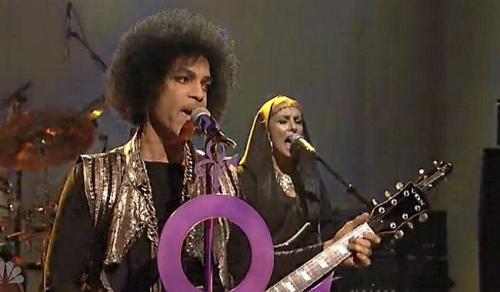
Prince SNL
Prince on SNL 11/1/14

My mom was the huge Prince fan in my family. I remember when I was a girl and she went to see Purple Rain when it first came out. It was one of the few movies I remember her seeing that I wasn’t allowed to see because I was under age.  When I was an adolescent I was kind of a prude about sex in music and I looked down my nose at music like “Like a Virgin” by Madonna, “Let’s Get Ill” by LL Cool J and “I Want Your Sex” by George Michael. They all made me uncomfortable.But the first time I saw Prince perform I was blown away and continue to have that experience watching him to this day.

I was watching “Solid Gold” the way I did every weekend when Prince was introduced. It was May of 1983. There was darkness and when the lights came on there was Prince. What was Prince? He started into one his biggest hits ever, “Little Red Corvette,” quiet and still and then he broke out into yelping and dancing and splits and tricks with the mic stand I had never seen before. He ended as quiet and still as he began and the lights came down and it was dark again before the audience burst into applause. And I just sat there in awe.  What was that hairstyle? Was he Puerto Rican? What was he? What was that? His mystique drew me in and has never stopped since.

The first time my mother took my brother and I to Trinidad in the 80s, I remember listening to her “Purple Rain” soundtrack on cassette over and over again to fight off my homesickness. I still hadn’t even seen the film at that point and I was already so attached to every track on that album, it was pretty ridiculous. “Darling Nikki” was a foray into a sexuality I did not find uncomfortable at all. Go figure. I mean there she was masturbating in a hotel lobby with a magazine. How that went down easier than “Like a Virgin touched for the very first time,” I cannot tell you. LOL! Needless to say I became a huge fan of Madonna, George Michael and LL Cool J as I got older but none of them have been able to outlast Prince’s place in my heart. It’s hard for me to be objective about Prince. My BFF and I share a very similarly diehard love for him that I believe has also informed the bonds of our long friendship. There are also certain Prince albums that hold within them seminal moments of my coming of age so much so that at one time, just listening to tracks from the Symbol album or the soundtrack to “Under the Cherry Moon” could trigger memories that were transcendent, sweet, painful and melancholy all at once.

I saw Prince perform for the first time ever a few years ago with my best friend in 2011. It was like a great big love reunion with someone you’ve never met before but have loved for so long. It was amaze-balls. You could feel in the energy all around that many of the serious day one fans were there. We would have stayed with him until daybreak.That night I bought tickets to see him again at MSG with my husband! I am not a big concert goer at all but I swear I lost my mind after seeing him for the first time that night. I had to see him again.

His performance on SNL this past Saturday brought part of that feeling back but with something new. Prince gets older as all of us do but his spirit, his dedication to his craft and the evolution of his talent is beyond my words to describe because I can’t be objective when it comes to Prince. How is it possible for someone to be around that long and still manage to have tricks up his sleeve no one has seen before? I’m not saying that I’ve loved everything Prince has ever done. And I’m aware he was a Grade A asshole during some of the most formidable times of his early rise to fame.  But I’ve never been bored by him. I’m always curious to see what he will do next. I love the way he seamlessly blends, interprets and incorporates a love of spirituality and sex in his music. I love his personal style and his love of play. He’s also one of the most disciplined Gemini I know and I still hope to be like him when I grow up. LOL!

VSCO: No Liking, No Following

Among many things I dabble in, writing, knitting, crocheting  and more, I’m also a photographer.

I had an interesting conversation with a guy at my job during a casual gathering a few weeks ago about what exactly constitutes dabbling (he loves the word dabble), enthusiast, “Geek”, fan and hobbyist. The discussion of what actually defines a photographer is one that never stops, especially with everyone and their mother out there with a cellphone and access to countless photo apps and filters to apply to each image. There was someone in my FB network who years ago would totally rip into people who shared photos they took with their cellphones and considered it photography or “art.” This person was classically trained in darkroom photography, developed their prints by hand and took great offense to what she felt was the lack of craft that went into most forms of digital photography.

Well…

I’ve seen some pretty bad photos that were shot manually and printed in a dark room as well. For me, it’s not the device. It’s the intention.

Which brings me to VSCO.com. Unlike flickr, instagram, dubble, or most any social network image apps, VSCO is about creating and viewing images only. You can follow people, but they will receive no notifications about who is following them and if you have an account there to display your images, you will never receive notifications on who is following you. And you can actively like all you want. But there is no like button, no comment button, nothing. You just post, look, get inspired and repeat. At least that’s what I do. Of course one of the other main points is for VSCO to promote their amazing film preset filters by providing this format to it’s many users. So this is very filmy, photo, geeky business going on here. It pretty much eliminates those who are just looking to rack up “likes” and “followers” for whatever reasons.

Last night I spent a lot of time on Adam Scott’s grid. I don’t know Adam Scott from Adam. I just found his images at random on the VSCO. I love his photos, particularly of kids and babies. I like when there is an emerging theme in people’s work. I’m not sure I have one in mine but I try not focus too much on creating one. I just use my grid to put up what I feel are my best shots.

This Tuesday I met a friend of mine for for lunch who also loves photography. He lent me his fixed prime lens for my Nikon. Someone needs to get me this lens for Christmas because it just makes me see everything differently. Like all of a sudden I can actually capture the beauty I see in everyday things and people and bring them to life. VSCO film preset filters are great for this as well. They really make me remember how much I love the look of film and how the very subtle nuances of those old films really shape my feelings and memories, and perpetually trigger my love for the art of photography.

I admit that as a person who is susceptible to wanting my images liked by faceless strangers on the internet, I often feel like VSCO cuts me off from what might be some critical feedback from some incredibly talented peers. But a community does exist there and their contact information is available. The VSCO grid is very clean and simple and shows only the work without any recorded data of likes or comments or follows. Those things make a huge difference in what people are drawn to looking at these days. The only curated or featured photography spaces on VSCO are those which the team chooses to highlight in it’s journal. Other than that, you’re free to shoot, post and view whatever you like, as long you’re okay with not having a trail of likes or followers behind you.

I’m fine with that.

I have two IG accounts. LOL!!

Room for Another?

Where does the craving to care for something or someone come from?

When I was around ten or so I remember specifically playing with one of my many baby dolls and being struck suddenly with the feeling that this whole situation was not a coincidence. I suddenly thought to myself that this whole baby doll rocking thing was preparation for the real thing. My reaction was nausea. The idea that a baby might be 100% reliant on me made me a bit sick. It was a short and fleeting moment but I remember it very well. My mind made the connection between play and a possible reality and I was a momentarily panicked little girl.

I’m always ready for play. Taking care of another person or thing besides myself? Not so much. But recently, I’ll say in the last two or three years, the need to love, to care for someone other than me has surfaced in my odd, aloof, anti-clingy sensibility. And it’s weird for me.

When I was a girl we had a cat that mostly my parents took care of and my brother and I played with. When she died as the result of a freak accident, my reaction was complete denial. My brother was way more emotional than I was. I kind of just couldn’t handle my feelings and sort of chose not to express them. When I think about it, that cat’s death was the first death I ever experienced in my family. I know a lot of people don’t take pets seriously or take them too seriously or hate people who take them too seriously or not seriously enough. We all have different feelings about it. But the fact is all pets are forms of life you take care of. Plants are forms of life you take care of. You benefit or don’t benefit from their being around in one way or another. But if you care you have to make room. You have to pay attention.You have to make time.

I have a plant, a plant I inherited from a co-worker who passed away years ago. And I was worried I wouldn’t be able to take care of it. I don’t even know what kind of plant it is, but I liked the look of it and it absolutely flourishes in my care. I water it once a week as directed, play music around it and occasionally talk to it and always take notice of its progress. I don’t have a green thumb. I don’t know if I would have this kind of patience with any other plant, just this one. I just happened to bond with it. There’s a plant someone dumped on me at work many years ago which I neglect shamelessly all the time. It’s sitting on my counter now as I write this.

Okay, I’ll water you today. Jeez.

All this is to say that yesterday, when my supervisor told me about a cat she took in to her home over the weekend, something about the way she described her just got me all emotional and choked up and not just because I’m a cat person. Apparently this is a domesticated cat that the owner or owners abandoned in the street. That broke my heart.  UGH! Just thinking about it now bothers me. My husband and I have also both been wanting a pet for ages. He loves animals! But like the prospect of having a baby, we’re both are in agreement that we need way more space first. But what if space isn’t really as necessary as we think for a pet or a baby? What if a pet is just a starter baby?

Sigh…

I want a cat.

I want a baby.

I want a cat baby. LOL!

What is “The Black Experience?”

I was never “Black” enough for the Black kids in my high school for whom society and dominate culture media would deem examples of “The Black Experience.” If a reporter came to my home looking for examples of the stereotypical “Black Experience” they would have found, lots of Tofu, whole grains, Golden Legacy Comic Books, handmade Christmas Ornaments, yearly PBS “Eyes on the Prize” viewings, in house play dates with the only Caribbean family that lived in our neighborhood, weekly trips to the Union Square Farmers Market, and the Food Coop in Brooklyn where my mom has been a member for years. They would have found me reading and journal writing obsessively while staring out the window of a large bedroom at a guy who I had a crush on who incidentally was probably living the life most likely to be voted as the “Black Experience” at least from the outside.

I used to buy into that bullshit too. I was as scared of outspoken, rambunctious, healthy black males in high school as any latently racist white person crossing the street to avoid them. Classism breeds these kind of destructive notions. They thought I was an “Oreo,” that I didn’t speak “Black,” that I thought I was all that. I thought they were too loud, disrespectful, “Ghetto,” mean and scary. None of us went any deeper than that until after a few years and even then, it’s taken me several High School reunions and a series of enriching friendships with people from different backgrounds to really appreciate the fact that among people of color, there is no “Black Experience.” What the fuck is that anyway? I never hear critics review movies with all white casts using words like “a slice of the White experience.” I do understand the need for the term in the Black community but from the mouths of White people it just exposes the usual narrow-minded ignorance that makes the daily news.

People of all colors, cultures and backgrounds have a human experience. Media sells us these categories to perpetuate a sense of classification, which unfortunately raises the constructed experiences of “Whiteness” to the level of sought after preference while it devalues, dehumanizes, denigrates, marginalizes and falsifies the experiences of people of color.

The funny thing about “Whiteness” though is that most everything they promote is stolen from an historic ethnic and or urban culture to be appropriated and repackaged on White faces and constructed White lifestyles. Am I saying that White people have no culture of their own?

I’ll go even further and say this.

Whiteness doesn’t really exist, just like “The Black Experience” doesn’t exist. Think about the definitions of each given to us in the media and really think about if you believe it’s true. The reality of what Black people experience in America as they navigate the odds of systematic racial profiling, poverty, bogus drug wars and a racist educational system is not “The Black Experience.” But it is the experience of a lot of Blacks.

Growing up, I didn’t experience poverty, drive by shootings, violence, a one parent household, or living in the projects. In fact, now when I think of it, I can see how specific incidents in my childhood communicated to me demonstrably, that people who did experience these things were not as valuable as me. For instance, growing up in Brooklyn my brother and I were strictly forbidden to run the streets with the kids in the neighborhood. I remember the strange tension I would feel climbing down a stoop with my brother and parents through a gauntlet of stoop sitters from the building and the neighborhood. They looked up at us with judgment. And we made sure to be friendly without really engaging. We made our way through to go off to some cultural and our extracurricular activity and we never really connected with these people. I never played hopscotch or double-dutch or handclapping games with the girls on my block. No time was spent on hot Brooklyn Summers running through illegally opened fire hydrant floods. Mine was not the Spike Lee directed Brooklyn “Black Experience.” I was pulling up weeds in the Children’s Garden, making Kachina dolls at the Brooklyn Museum and filling my head with stories at the RIF club in the Brooklyn Public Library.

But I remember those hopscotch and double-dutch, hand-clapping girls. I wanted to double-dutch. I still thrill at the skill of double-dutch. I still don’t know how to do it. I used to mimic their movements as a girl at home when I was alone. I guess we all miss out on experiences we wanted to have because of invisible gaps and lines we didn’t draw and don’t understand the meaning of.

I just know I don’t want anyone defining my experiences for me but me. When I wore apparel in High School that said, “It’s a Black thing, you wouldn’t understand.” It was in response to a dominant White culture that told me my experience wasn’t as important, valuable or significant because I lived in Black skin. That’s the reason I chose to start my locs in high school. I wanted to be an example to Black girls my age that being natural was okay too, that it was in fact just as good as straightening or relaxing, or hair extensions all of which I had done to my hair as well. But I was also told by some of my Black peers that my experience wasn’t shit to them because it wasn’t “Black” enough. That confused and angered me. I guess it still does. But as an adult, I’m very careful not to respond to those kinds of one-dimensional assessments by being one-dimensional myself. I know that as people of color, our experiences are broad, complex, diverse and ridiculously untold by popular media and culture that would have the world believe that the “Black Experience” is the single story and that the experience of those who define themselves as White is just the human experience.

Where the Black People Are

Is that a Black person following me on Flickr? No? Oh. Okay. Hey is that a Black woman in a feature on a Mind Body Green article? Oh. no. Hey, is that a Black person following me on IG? Oh cool! I look them up, check out their profile, look at their images, etc.

When I got married in June of this year, a trusted adviser (A woman of color if you haven’t gotten the gist) recommended the magazine New York Weddings to me. When I finally found a copy at Barnes & Noble  I noticed that, like New York Weddings, every single wedding magazine had a white woman on the cover. Flipping through one or two of these magazines didn’t reveal much diversity in ads or feature articles. Wedding dresses are white enough! I needed to see some color and variety in shapes in these dresses. I never bought one single wedding magazine during the months of planning leading up to my wedding.  I just couldn’t. This was too important. And with things that are this important in my life, marriage, art, health and more, I get excited when I see Black and Brown faces representing. And as a Black woman I am always aware of the fact that I have to go looking.

We have to go looking.

With dolls, we have to looking, with hair products we have to go looking, with children’s books we have to go looking, with photography we have to go looking. Quick! Name a famous living Black Photographer! No, not Gordon Parks! I said living. I said famous. Not too easy is it? Is it because they don’t exist?

Carrie Mae Weems exists. I don’t mean to be condescending. I know you all knew that.

Right?

Getting back to my point. When I was getting married I found a site and Web Magazine called Munaluchi Bridal Magazine, the only one I’ve found so far which featured Brides of color in all phases of nuptial and post nuptial planning from engagement photos to wedding ceremonies to mommy to be images. And that was one of my most primary references for ideas about my own wedding. I was so happy too see Brides of color in my IG feed every week and not just the standard stick thin models but actual real women of color with real bodies getting married all over the country and sometimes the world! There is where I stayed.

About  a year ago, Life as I Know It told me about a nail shop in my neighborhood in Harlem called Bed of Nails. B.O.N. is owned and run by a young Black woman who hires Black nail technicians. I had my own reservations about going there for the first time, the kind anyone would have about a brand new place of business. Would they know what they were doing? What would the ambiance be like? Would they be nice? I made my appointment, showed up one afternoon and the minute I walked in I was greeted by a sister who took my coat and offered me a choice of tea or a mimosa.

HUH? YES PLEASE!

Exposed Brick on one side and a wall of designer nail polish from Christian Louboutin to Deborah Lippmann on the other. Six velvety Black high back chairs set up in the back for pedicures have a very inviting and royal  to them. A large purple sofa in the waiting area with natural light streaming in from the window behind you. It’s a very warm atmosphere, not just because of the layout and design of the place but the treatment, professionalism and yet laid back casualness of it all. No one is rushing you in and out. They want to be there and they want you to be there as well. Plus they play the best mix of hip-hop/R&B up at the front desk while you’re getting your nails or feet done. It’s so relaxing. And there I stay. I never go anywhere else to get my nails done. This is the experience I want. If there was a Black owned, Black run Bed of Nails chain in Midtown Manhattan I would go there.

The reason I bring this whole subject up is that there are certain white people who like to pull the Racist card whenever Black people manage to organize or build anything of their own or patronize Black owned businesses exclusively that cater to the people in their community. Listen. If I didn’t have to go looking so hard for representation of Blacks in the areas of life that are most important for me in the first place, this wouldn’t even be an issue. It’s not my fault that dominant culture has tipped the scales in it’s favor for so long that any logical attempt towards filling the needs which are not met by this culture will be interpreted as “Reverse Racism,” a term whose definition I will not even dignify with a discussion because it is a fiction.

The idea that you get to fuck with descendants of African people for this long, tell them to get over it so that you can absorb them in a culture that is defined and built on a foundation of theft, genocide, appropriation, assimilation, and gentrification of native and indigenous spaces is what’s really sick and racist.

If I decide I want to go away to an island where only Black and Brown people exist (and sometimes I really do), I damn well have every right to. After all, White people do this all the time.

It’s called a vacation.

You may not always get what you want

So I have been at my desk literally for like 45 minutes talking to our IT tech about kids. He’s a 42yr old father of four and apparently he’s losing his mind. He asks me if I want to start a family and I said yes. He told me not to wait too long and a 45 minute conversation ensues. Another of our co-workers, a much younger female has a little girl who seems to be the light of her life joins us and give a little of her own perspective. I am pushing back as much as I can on the notion that having kids as an older person is the worst idea ever because…well I’m older. And he’s a dude so what does he know?

He knows plenty.

I won’t go into details but during our conversation he said something that really rang true to me in my zero years of being a parent but having read an excellent parenting book a few months ago entitled “The Conscious Parent.” He said in response to the negative way in which his wife was responding to her son who has a severe mental disorder that she had to “mourn the death of the child she wanted to have” and confront the one in front of her.

WHOA.

WHOA.

Yeah, Dr. Tsabary totally explained that in a different way in “The Conscious Parent” but this is the first time I’ve heard anyone I know say anything like that with regards to child rearing. This is why it’s so important to talk to people in person, you know…as opposed to disjointed virtual or one way dialogues in social networks.

Every parent has an idea of the kind of child they want and what I am learning among so many other things as someone considering late motherhood, is that there can be a deep emotional heartbreak involved when you have a child who is totally different than what you desired or expected. Behavioral patterns are one thing. Handling mental disorders or birth defects are something I cannot even imagine. But I know that people deal with their children the way that they they deal with people and life challenges in general and that people often look at other people’s children totally differently than they see their own. You never know what you’re going to get.

I have to be honest, that freaks me out a bit. But not enough to say I will never have a child. I understand that there is always risk involved where creation or birth is concerned and that we all meet challenges in different ways and for different reasons. I can also tell you that I came away from the conversation with a deeper respect for the institution of marriage because children need to know why they are how they are and to be able to connect their identities through their family line and this can be done most successfully through documented forms of ritual unions. We inherit behavior and for better or worse I believe we are able to make better decisions for ourselves once we learn how the connections to our patterns of our behavior have played out in the past, through those who were here before us, our ancestors, and those who still remain. If we are caught up in a bad cycle, we can understand why and begin taking steps towards both acceptance and awareness, thereby breaking that cycle.

I remember sitting in the pastor’s office with my husband several weeks before we got married and going over our family trees together. Wow. If there is ever anything to inform you what your children might possibly be inheriting emotionally and behaviorally, family tree talk is the one. It’s a moment when you realize that you are marrying into one another’s families. It’s a confidential meeting wherein you look at all the twists and turns, losses, gains, disconnections, triumphs and points of pride and celebration or achievement. It’s intense. It’s real. Not everyone knows who their real daddy is. Not everyone is doing okay or accepted into the fold. Not everyone did what was needed or expected of them. That’s life. Some people break from their blood family altogether and find that connection spiritually with others. But you only get one set of parents in your life. And they don’t just bring you here. They have plans. Those plans can make you, break you or shape you depending on how you choose to look at it. As human beings we often operate from a place of unresolved fears. I have plenty of my own. But I don’t want them to come to define who I am as a person or the choices I make, especially the choice of whether or not to have a child.

How to be a Black Woman and remove your make-up in “How to Get Away with Murder”

viola davis

When was the last time you saw a leading actress remove all her make-up in an extended, tight, super close up shot?

The only scene that leaps to my mind is Glen Close as the Marquise in the last few minutes of “Dangerous Liasons,” one of my all time favorite films. As she removes her make-up in a show of total ruin we see how truly ugly she is in spirit because she has destroyed any chance there ever was for love in her life. Now it’s Viola Davis in the last ten or so minutes of the last episode of “How to get Away Murder” when she removes all her make-up and gains more and more ground with every swipe.

I’m only just beginning to immerse myself in the series and I have to admit, I still have not seen the first episode in its entirety as yet.

I KNOW! DON’T THROW THINGS AT THE SCREEN.

I think I was just a bit annoyed at all the law student characters. All I wanted was Viola but they’re starting to grow on me and I can see where they are essential to the plot and the movement and development of the show. There have only been four episodes of the series so far and with each one, I see more than I’ve never seen in any television series before.

For instance, I think it was in one the two episodes before the last that Annalise is shown at her home taking off her wig revealing her own short natural hair, pinned back to her head. I was not prepared for that and was immediately intrigued by the fact that Shonda included this reveal with zero fanfare. I watched Annalise deep in thought, and sitting in bed alone and something in me was just like wow. This happens all the time, everyday. Women come home, take off their wigs, make-up, sit in front of a mirror and contemplate. But rarely see this process documented on screen. The idea with everything women do to beautify themselves or appear presentable, particularly Black Women (because we’re not supposed to consider ourselves beautiful unless we have applied some cosmetic form of skin lightener or hair straitening, curl loosening potion) and especially as power players in a high level positions, is that even if the world knows your appearance is a constructed facade based on white standards of beauty, or male standards of power, you never show the world how you put it on or take it down.

V Davis Make-upWhen Annalise is shown in this last episode, not only taking off her perfect wig but slowly removing all of her make-up in front of her dresser mirror, there is such a powerful and subtle statement being made. It was no surprise for me to learn that this was actually Davis’ idea.  The removal of all her cosmetic arsenal does not disarm an actress like Viola Davis. And I don’t believe it is meant to disarm her character. You don’t even get the sense that she cares about any of it. She’s quite beyond the power of make-up or wigs to define who she knows she is. The scene is electric with the building up of inevitable confrontation with her husband. It addresses a multitude of systemic relational dynamics by engaging the audience with it’s own feelings about what is taking place rather than making Annalise a victim or soul representative of something many Black women fall prey to with regards to the dominant culture’s construction and evaluation of female beauty.

This scene is not primarily about make-up or wigs the removal of them or their application. Shonda just shows you what happens in the households of nearly every adult American woman alive on a daily basis. She leaves it up to you and proceeds on with the development of the story.

That Wrap Life

Back in the 90s when Brand Nubians, Neo Souls and the Zulu Nation were emerging, my BFF and I started rocking our newly started locs and mudcloth headwraps in high school and to date that is the last time I can remember wearing them. I do wear one to bed but that’s just to protect my locs from damage and dryness and to lock in conditioning treatments.

All my life I’ve seen many woman of color rock some fly ass head wraps both in cultural and casual contexts but I have never had the confidence to try it myself using the Ankara print fabrics. Plus I was never very imaginative with mudcloth. I basically just wrapped it around my head like a wide band that pulled my hair back. There was no real art to it.

I really love the way these tutorials from Wrap Life make make the process of head wrapping more accessible and less intimidating. As much as I love to be creative and make things by hand, I’ve never been able to figure out how African women are able to create these amazing shapes around the head with these large beautiful pieces of fabric, but these fun videos are inspiring me to give it a try.